At Shelby Yard, our mission has always been to provide the most effective, durable, and professional drainage solutions for Memphis and Shelby County residents. That starts long before anyone puts a shovel in the ground — it starts with understanding the soil.
Most drainage systems that fail in Memphis weren't installed badly. They were designed badly — sized, sloped and placed as though the yard were ordinary soil.
Why Memphis Soil Breaks Standard Drainage
Memphis sits on Peoria loess, a wind-deposited clay containing up to 40% smectite. Smectite is expansive: it swells when it takes on water and shrinks as it dries out. That single property drives most of the drainage trouble in Shelby County.
What that cycle actually does to a property:
- Low permeability — water doesn't soak in, it sits on the surface or runs sideways
- Hydrostatic pressure against foundations during long wet stretches
- Void formation beneath slabs and beside foundations during dry spells
- Seasonal movement that reopens the same gaps year after year
- Saturation overload — roughly 54 inches of rain a year, often in short heavy bursts
A trench and a pipe don't address any of that. Neither does a system copied from a spec written for sandy soil in another climate.
What We Measure Before We Design
So how do we design around a soil that moves?
It's simple: we measure the property instead of assuming it.
Every assessment captures the data that determines whether a system will work — and none of it can be eyeballed from the curb.
🔬 Diagnose the Root Cause
Elevation profile, grading direction and the specific zones where water collects. Standing water that lingers more than 24 hours after rain means water has nowhere to go — not that the yard needs more time. We find out where it's trying to go.
🎯 Design to Documented Standards
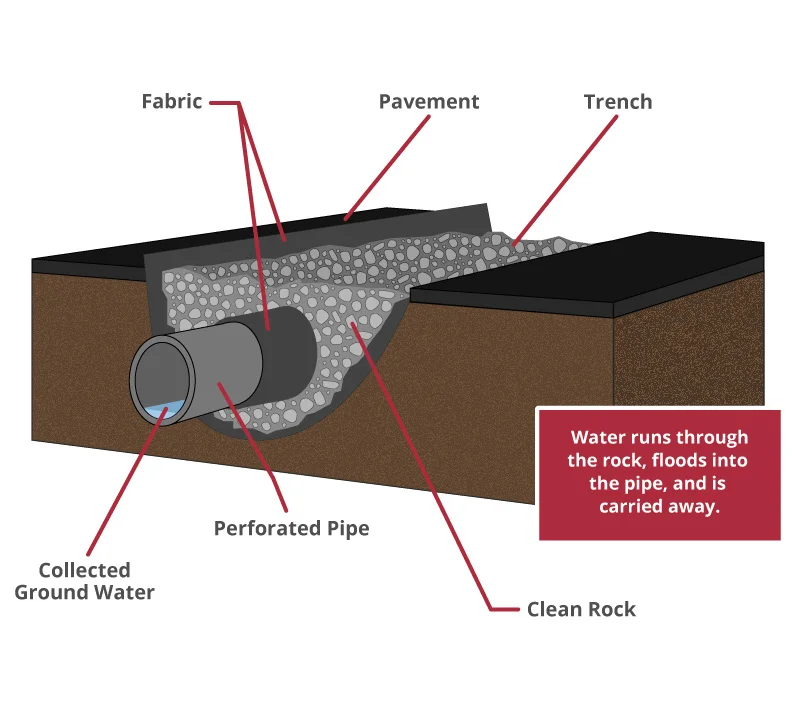
French drains get a minimum 1% slope, 4-inch perforated HDPE pipe, a washed #57 limestone envelope and a non-woven geotextile wrap, buried at least 12 inches. Catch basins are sized for the volume they actually have to carry. These aren't preferences — they're the specifications that make a system last.
✅ Install With Accountability
Shelby Yard is an NDS Certified Professional Drainage Contractor. Every installation is licensed, insured and warrantied — so the design decisions we make are ones we stand behind after the crew leaves.
Where Most Contractors Stop Short
The difference isn't equipment — every contractor has a trencher. The difference is whether anyone measured before deciding what to install.
When a contractor quotes a linear-foot price over the phone, they're pricing a product, not solving a problem. That's how a yard ends up with a correctly built drain in the wrong place. Designing from site data instead means:
- More accurate problem diagnosis using measured elevation and observed drainage behavior
- Optimized system design based on Memphis-specific soil and rainfall conditions
- Long-term performance from systems built to documented specifications
- Fewer surprises, because the scope reflects what's actually on the property
How the Measurements Change the Design
It is easy to say “we measure first” and leave it abstract. Here is what the numbers actually decide.
Elevation drop decides whether a gravity system is possible at all. A French drain needs a minimum 1% slope — roughly one inch of fall for every eight feet of run. On a flat Memphis lot with only six inches of drop across sixty feet, you have exactly enough, and only if the outlet is placed at the lowest available point. Measure it and find four inches instead, and the honest answer is that gravity will not do the job: the design changes to a collection point and a pump, or the outlet moves. A contractor who never measured will trench it anyway, and the system will hold water in the pipe from the first season.
Contributing area decides pipe and basin size. A catch basin serving a 400-square-foot patio and one serving a 2,000-square-foot roof plus its driveway are not the same component, even though they look identical in a catalog. Memphis rainfall arrives in bursts — an inch in an hour is an ordinary summer event here, not an extreme one — so sizing to the average annual rainfall rather than to peak intensity produces a system that works nine months a year and fails in the three that matter.
Soil behavior decides the envelope. In sandy soil, a perforated pipe in gravel works because the surrounding soil feeds water to it. In Peoria loess it does not; the clay holds water rather than releasing it sideways. That is why the specification calls for washed #57 limestone rather than whatever aggregate is cheapest, and for a non-woven geotextile wrap rather than the woven fabric sold for weed control. The stone provides the void space the clay cannot, and the fabric keeps clay fines from migrating in and filling it. Skip the wrap and the system silts closed in a few years — not because it was installed badly, but because it was specified for the wrong soil.
Outlet elevation decides whether any of it matters. Every component upstream is irrelevant if the discharge point is not meaningfully lower than the inlet and clear of obstruction. This is the single most common failure we are called out to diagnose, and it is nearly always visible in the original design rather than something that developed later.
What to Ask a Contractor to Show You
You do not need to be an engineer to tell whether a design was measured or guessed. Four requests separate the two, and any contractor working from real site data can answer all of them on the spot:
- Show me the elevation drop from the problem area to the proposed outlet. A number in inches or feet, not “it slopes that way.”
- What area is this system collecting from, and what does that work out to in a one-inch-per-hour rain? This is the sizing calculation. If it was done, it can be stated.
- Where exactly does the water discharge, and what is the elevation there? Ask to walk to the spot.
- What pipe, stone and fabric are you specifying, and why those? The answer should reference the soil, not the price.
A contractor who has measured will find these questions unremarkable. One who quoted by the linear foot over the phone will change the subject to experience or references. Neither response is a character judgment — it just tells you which kind of proposal you are holding.
What This Means for Memphis Homeowners
If you're dealing with drainage issues, the practical upshot is that your solution should be specific to your lot. Whether you need:
- A French drain system designed for your specific soil conditions
- Exterior foundation drainage engineered for Memphis clay soil
- Surface drainage solutions — catch basins and regrading — optimized for local rainfall patterns
- Complex drainage problems requiring detailed site analysis
You should expect a contractor to explain why the system is laid out the way it is — and to base that answer on something they measured at your property.
Related guides:
Looking Forward
Shelby Yard remains committed to our core values of quality, reliability, and customer service. Designing around the soil rather than in spite of it is how we deliver on those commitments with precision and confidence.
If water is collecting somewhere it shouldn't, the first step is a proper look at the property. We're glad to come take one.
Free Download
Not sure if your yard needs a French drain or catch basin?
Download our free Memphis Drainage Checklist — 7 signs your yard is silently damaging your foundation, with urgency ratings and what each sign means. Memphis-specific, no fluff.
No spam. Unsubscribe any time.
Is your yard showing any of these signs?
Tell us what's happening — we'll tell you exactly what it needs and what it costs. Most Memphis homeowners get an answer within minutes.