You've got standing water in your yard that won't go away. You Google for help and hit a wall — plumber? Landscaper? General contractor? The trades overlap enough to be genuinely confusing. Here's a straight answer.
The Short Answer: Call a Drainage Contractor

Yard drainage problems — standing water, soggy lawn, water pooling against your foundation — are the specific territory of a drainage contractor, also called a yard drainage specialist. Not a general plumber (who handles indoor pipes), not a landscaper (who handles plants and grading, but not engineered drainage systems), and not an interior sealing specialist (who deals with water that's already inside your home — a separate trade from exterior drainage).
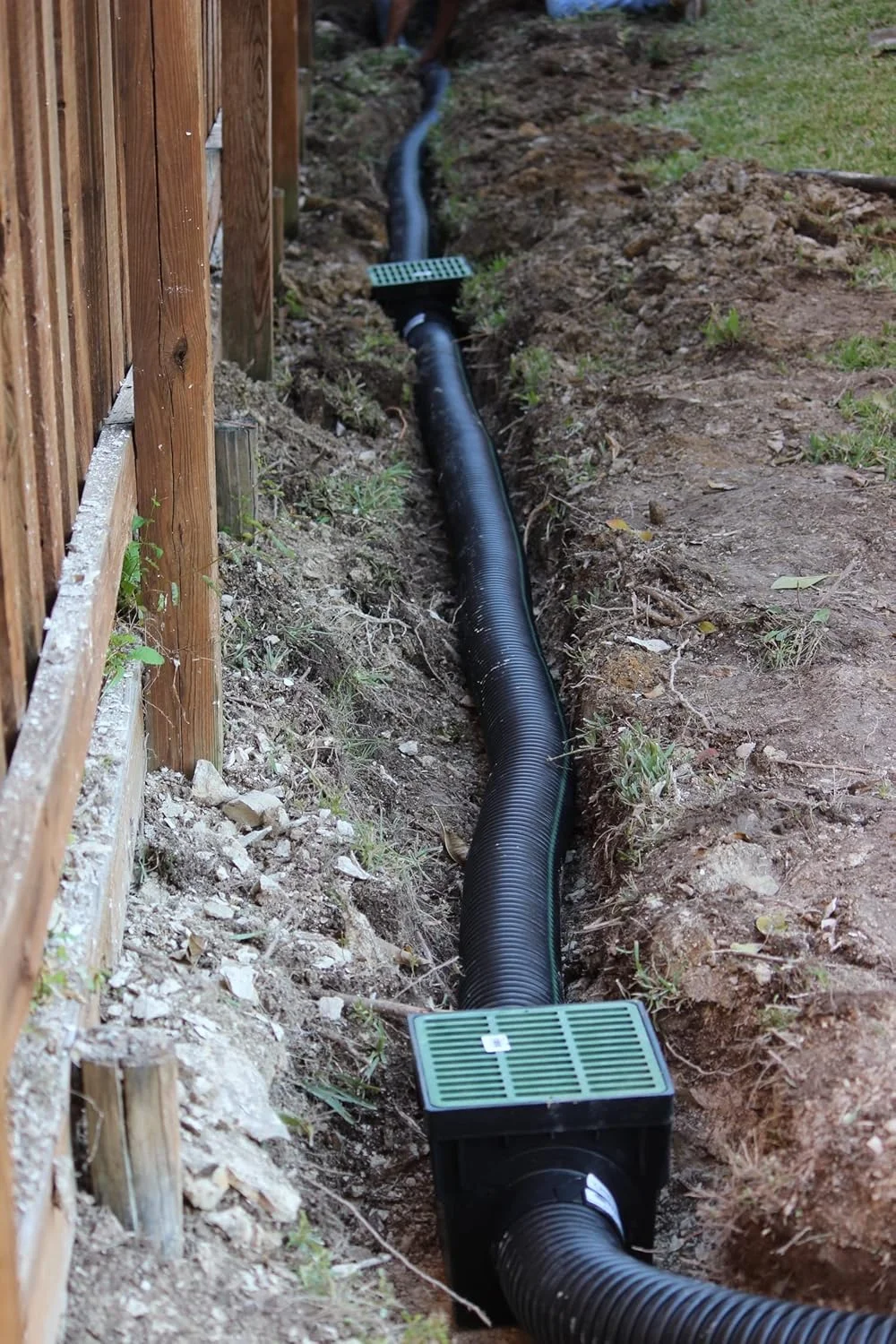
A drainage contractor assesses how water moves across and through your property, identifies why it's accumulating where it shouldn't, and installs systems — French drains, catch basins, downspout extensions, regrading — that redirect it permanently.
When the Problem Might Be Something Else
Before you call anyone, a quick check helps confirm you actually need a drainage contractor versus another trade:
- Water inside the basement after rain: Could be a drainage problem outside or a crack/seal failure inside. Start with a drainage contractor — they can assess the exterior grading and drainage, and tell you if the cause is instead inside the structure, which is a different trade entirely.
- Water backing up through a floor drain or toilet during rain: That's a plumbing or sewer issue. Call a plumber first.
- Gutters overflowing: Could be a gutter cleaning/repair job, but if water is pooling at the foundation after gutter work, a drainage contractor should check the downspout discharge path.
- Lawn is consistently soggy in one spot: Classic drainage contractor territory — likely a low point, clay soil compaction, or failed previous drainage attempt.
What a Drainage Assessment Actually Involves
A proper yard drainage assessment isn't a quick walk-around. A qualified contractor will:
- Map the slope and grade of your property to understand how water flows
- Identify the source — whether it's surface runoff, groundwater seeping up, downspout discharge, or a neighbor's yard contributing water
- Check the soil — in Memphis, nearly all residential lots have dense Shelby clay, which holds water rather than draining it
- Inspect any existing drainage infrastructure (catch basins, downspout connections, old French drains) that may have failed
- Propose a specific solution with a clear outlet — where the water will actually go once it's collected
If a contractor shows up, looks at your yard for five minutes, and immediately proposes a solution without asking about your soil, your slope, or where the water will discharge — that's a red flag.
Why Memphis Drainage Is Different
Memphis sits on some of the heaviest clay soil in the country. Shelby County clay absorbs water slowly and holds it for days after rain. A French drain system designed for sandy Georgia soil won't perform the same way here — the pipe sizing, gravel selection, slope requirements, and outlet placement all need to account for clay behavior.
Our assessments start with measurement, not assumption — elevation drop, grading direction, downspout load and the behavior of Memphis's shrink-swell clay on your specific lot. Shelby Yard is an NDS Certified Professional Drainage Contractor, and that level of site analysis isn't something you'll find at most contractors.
Questions to Ask Before You Hire
When you call a drainage contractor, these questions separate professionals from guessers:
- "Where will the water discharge?" Every drainage system needs a legal, functional outlet. If they can't answer this specifically, keep looking.
- "What permits are required?" In Memphis and Shelby County, drainage work often requires permits. A contractor who skips permits creates future problems for you when you sell.
- "Do you warranty your work?" Drainage systems should carry at least a 1-year warranty on installation. Materials warranties from manufacturers are separate.
- "Have you worked with Memphis clay soil specifically?" General drainage experience doesn't automatically transfer — the clay behavior here is distinct.
What It Costs to Fix Yard Drainage in Memphis
Typical ranges for the most common solutions:
- French drain installation: $1,500–$5,000 depending on length and depth
- Catch basin installation: $500–$1,500 per basin
- Downspout drainage extension: $300–$800 per downspout
- Landscape regrading: $1,000–$4,000 depending on area
Most homeowners need a combination — a single catch basin usually isn't enough if the underlying grade is wrong. Get a full assessment before agreeing to any single fix.
What the Work Actually Looks Like
Most homeowners have never watched drainage work happen and imagine something more disruptive than it is. A typical residential job runs one to three days. Day one is layout and excavation — a trencher or mini-excavator opens the line, and the spoil goes onto tarps rather than onto your lawn. Day two is the system itself: pipe bedded in washed stone, wrapped in geotextile, basins set to elevation, and everything tied to the outlet. The last stretch is backfill, compaction and surface restoration.
Two things are worth knowing in advance. First, the yard will look worse before it looks better; a fresh trench line takes a season to blend in fully, and sod laid over it settles. Second, ask before work starts whether restoration is in the scope. “We’ll put the dirt back” and “we’ll re-sod the trench line” are different commitments at different prices, and the gap between them is a common source of end-of-job friction.
Utility location is not optional. Any contractor trenching on your property should have called 811 and had lines marked before the first cut. If they arrive with no markings on the lawn, that is a stop-work moment, not a detail.
What It Costs to Get It Wrong
The reason it is worth being careful about who you call is that drainage is expensive to redo. A system installed at the wrong slope, or discharging to a point that is not actually lower than the inlet, does not partially work — it holds water in the pipe and silts closed. Fixing it means excavating the same trench a second time, and the second job costs more than the first because someone has to remove the failed system before installing the replacement.
The larger number is what the water does while the system is not working. Persistent moisture against a Memphis foundation drives the shrink-swell cycle that opens cracks, and foundation repair in Shelby County starts in the five figures. Nobody spends $3,000 on a French drain because they want a French drain; they spend it because the alternative is considerably worse.
When to Call
The honest answer is before the wet season, not during it. Memphis averages roughly 54 inches of rain a year, and it is not evenly distributed — the wettest stretch runs from late fall through spring, with April typically the heaviest month and August the driest. Standing water in July is a warning; standing water in February is an active problem with a queue of other people ahead of you.
Practically, late summer and early fall are the best time to have an assessment done. The ground is workable, contractors are not yet booked out by storm-season calls, and any system installed then has time to settle before it is genuinely tested. Waiting until the yard is already saturated means both a harder installation and a longer wait for a slot.
Related guides:
If You're in Memphis or Shelby County
Shelby Yard specializes specifically in yard drainage for Memphis-area homes. We offer free on-site assessments — no obligation, no pressure — and every quote includes the full scope of work with a clear outlet plan. Our work is backed by a 1-year warranty and our installations account for the specific challenges of Memphis clay.
Call us at 901-864-3411 or use the chat widget to describe your situation. If you can tell us where the water is coming from and where it's ending up, we can usually give you a ballpark before the site visit.
Free Download
Not sure if your yard needs a French drain or catch basin?
Download our free Memphis Drainage Checklist — 7 signs your yard is silently damaging your foundation, with urgency ratings and what each sign means. Memphis-specific, no fluff.
No spam. Unsubscribe any time.
Is your yard showing any of these signs?
Tell us what's happening — we'll tell you exactly what it needs and what it costs. Most Memphis homeowners get an answer within minutes.